Envato and Microlancer - Lessons in building together
Layla Foord
A reflection on my last day at Envato, the team that helped build Microlancer from prototype to marketplace, and why the people around the work often matter more than the story a CV knows how to tell.
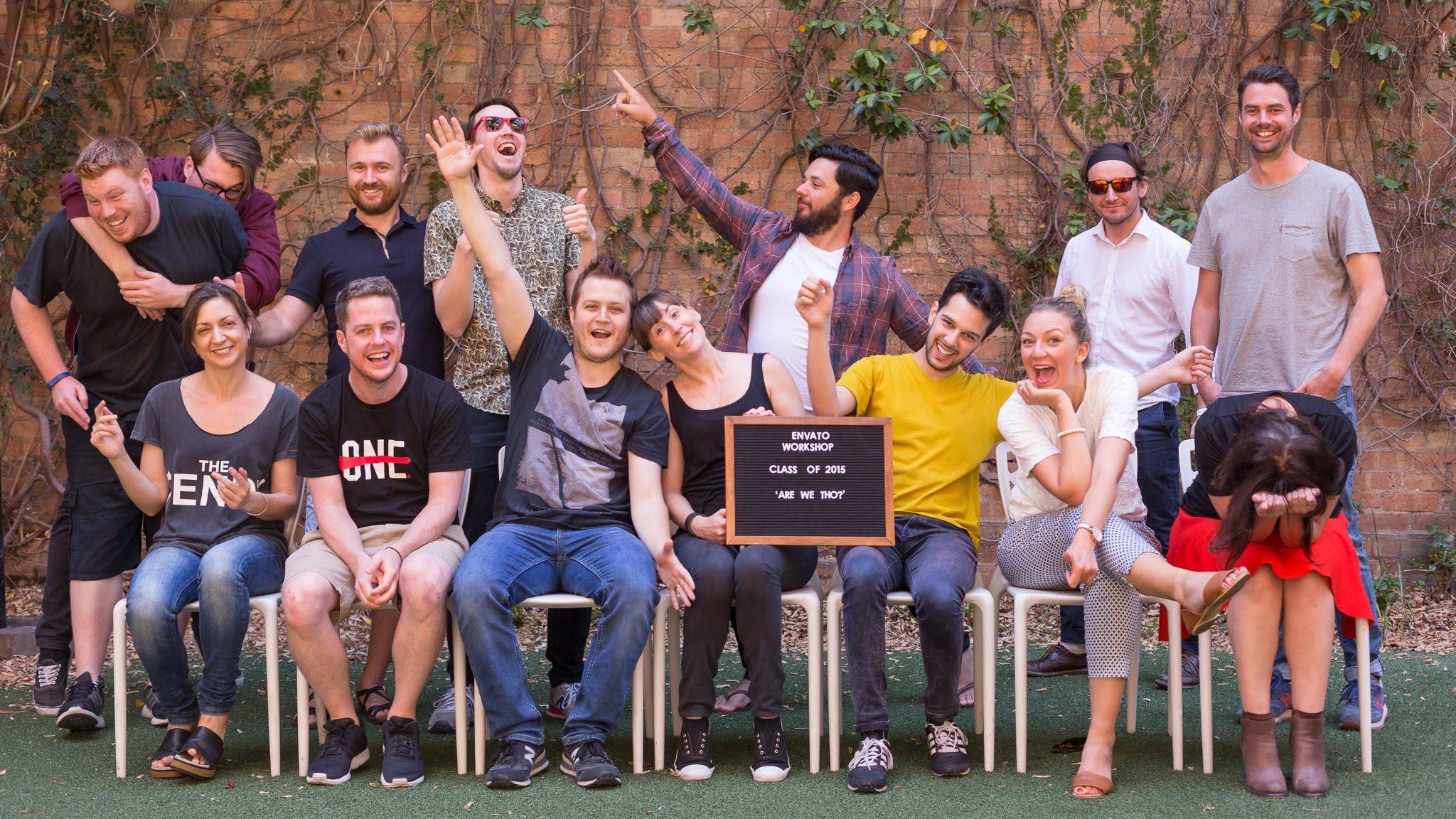
There is a photo from my last day at Envato that I still love.
Not because it is polished. It isn't. It is a group of us in the courtyard, half posed, half collapsing into whatever was actually happening, with one person folded over laughing, someone else waving, someone holding a little letter board in the middle that says Envato Workshop, Class of 2015, and underneath it, "Are we tho?"
It was a surprise.
My team had arranged the shoot, and later that night we went out for karaoke, which feels right. Some teams go for polite drinks. Some teams send a card. This one made a scene in a courtyard and then went singing.
I look at that photo now and I do not see roles.
I mean, technically they were there. Engineers, designers, support, marketing, product, operations, people with titles that helped the company understand roughly where to place them in the system. But that is not what I see when I look at the photo now.
I see people whose lives have gone in all sorts of directions since then, which is part of why the photo means more to me now than it probably did at the time. One became a best-selling novelist. One a serial entrepreneur and Tokyo residency artist. There was a management buyout of a milkshake app in there somewhere, a photographer who likes jumping out of planes, two brothers who once weighed trucks at the dump and now develop and support huge apps, and a father of twins in the middle holding the sign, who never seemed to wait for permission. There was a genius engineer who is still helping me transform Smiling Mind's technology today, a marketer whose loyalty and support still feel almost unrivalled, someone who carried sunshine into the room without making a big performance of it, and a world-class engineer, one of the first women I knew absolutely killing it in technology before people had learned to talk about that properly. And there was the person pointing from the back, who I barely had time to know properly before the team moved on, but who I later discovered had produced a TV show for the ABC, which somehow feels exactly right for this group.
Not in the overused way people say that when they cannot think of anything more specific. I mean it literally. Each of them contains more story than their job title could ever hold. Each of them had a life before the work, and a life after it, and a strange set of talents and histories and choices that made them who they were inside that room, inside that team, inside that moment.
I think about that a lot now.
How easy it is, especially in product and technology, to talk about teams as capability sets. Design capacity. Engineering velocity. Support coverage. Marketing alignment. Delivery confidence. Resourcing. Org shape. Talent density.
All useful language, in its place.
But none of it tells you who is actually sitting in front of you.
Working at Envato was one of the most challenging and rewarding periods of my working life. I was working with founders who were incredibly talented, smart and humble, and also deeply attached to what they had built, in a way that meant I had to learn how to slow my thinking, listen more carefully and make the work visible before asking anyone to move with it.
I had to slow down.
I had to listen more.
I had to stop assuming that because I could see the shape of something quickly, that meant the system was ready to move quickly with me. It often wasn't. They needed the thinking written down. Properly. Long-form. Carefully. Not because they were difficult, although sometimes they were. But because what we were doing mattered to them, and they wanted to be able to see it, question it, hold it, pull it apart and decide whether they trusted it.
It was the first time since school that I really learned to write long-form again.
Not as expression, exactly. More as a way of slowing my own thinking down enough for other people to come with me. That was humbling. And useful. And annoying. And, with hindsight, probably one of the most important shifts in how I learned to lead.
Collis trusted me with something important.
I could see that at the time, but only partly. It is only with hindsight that I can feel the weight of it properly. He handed me something that mattered to him, something connected to the Envato ecosystem but not fully inside it, not cushioned by certainty that the thing would work, and not something that could simply be pushed into the world by the force of the existing brand.
At first it was called Microlancer.
It had funding and belief behind it, but it was not simply carried by the main Envato brand or pushed into the world by a large marketing machine. It still had to prove itself in the hands of real customers and real designers.
So we gave it a red-hot go.
Within a few weeks we were live with a prototype. Not perfect. Not polished in the way people sometimes pretend launch versions should be. But real enough to learn from. Real enough to test whether people wanted this thing, whether designers would come, whether customers would buy, whether the edges of the marketplace held when actual money and actual work started moving through it.
Six months later, we had around 100 designers on board and had delivered $1 million worth of jobs to people all over the world.
That is the line that goes into the career story.
It is a good line.
I am proud of it.
But it is not the part I am most proud of.
By the time it was alive and working, it was also becoming clear that the next phase needed a different kind of stewardship. Collis and I talked about that honestly, and together we decided it made sense for me to move on. The team shifted into a new division, the marketplace kept evolving, and I left with that strange feeling you get when something has worked, but the part you were there to do is finished.
The part I am most proud of is harder to put on a CV. It is the culture. The community. The care. The strange little system we built around the work that made the work possible in the first place.
Despite the option to work remotely, people came in.
Not every day because they had to. Not because anyone was pretending that sitting in an office was automatically more productive than being at home. They came in because the room had something in it. The team had something in it. The work was better when people could swivel their chair, ask the question, hear the tone, notice the support tickets rising and pull someone over to figure out why.
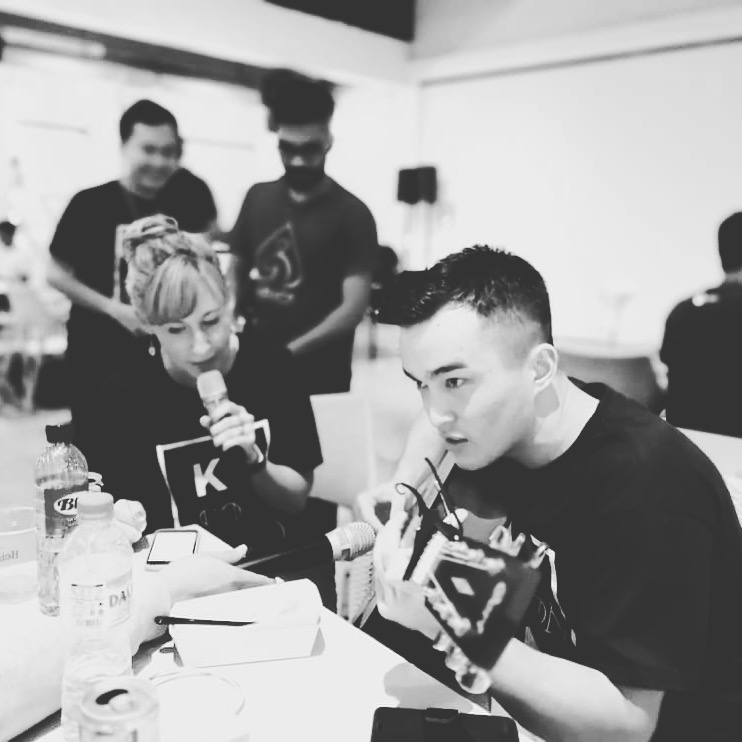
Rod, who is not in the photo, played guitar at stand-up.
My tiny daughter sat on a bean bag playing with Shervin while we tried to understand why support tickets had increased.
There were founders, future founders, engineers, designers, support people, marketers, oddballs, quiet geniuses, people with sharp edges, people with soft centres, people who needed space, people who made the room warmer just by being in it.
We were lucky enough to have some extraordinary people on that one.
A very smart and annoying guy who went on to found Buildkite.
Another who helped lead the early technical scaling at Culture Amp.
People who would go on to build serious things, beautiful things, useful things, strange things. People who would become more visible later. People whose names would eventually sit beside brands other people recognised.
But I do not want to only name the people whose later achievements make the story easier to understand from the outside.
That would miss the point.
The point is that they were all bright stars. Not just the ones with fancy titles or recognisable company names on their resumes. Not just the ones who became founders. Not just the ones who now look impressive in retrospect.
All of them.
The person who noticed the customer pain before the rest of us had language for it.
The person who quietly made the thing work.
The person who kept answering tickets with more patience than most people deserved.
The person who held the team together emotionally without ever being formally asked to.
The person who made the room funnier.
The person who pushed too hard because they cared.
The person who stayed late.
The person who asked the awkward question.
The person who made everyone feel like the work belonged to them too.
That is the thing about teams. You can describe them through output, but you only really understand them through the texture of how the work happened.
And at Envato, the texture mattered.
There was craft in it. There was stubbornness. There was community. There was friction. There were founders who cared so much that sometimes the care came out sideways. There were constraints that forced clarity. There was a small team trying to build a marketplace from scratch without pretending the world owed us attention.
We made good things.
But I do not think we made them because we were individually brilliant, although plenty of people were. I think we made them because, for a while, enough people cared about the same thing at the same time and were willing to sit in the mess of it together.
That is rarer than people think.
Work often asks people to collaborate, but does not always create the conditions for people to belong to the work. There is a difference. Collaboration can be a process. Belonging is something stranger. It happens when people feel the thing is partly theirs, not because someone said the word ownership in a planning meeting, but because they have touched enough of it, fought for enough of it, shaped enough of it, and been trusted enough inside it to feel responsible.
I think that is what we had.
Not perfectly. No team is perfect. I am sure there were things I missed, things I handled badly, moments where I moved too fast or did not listen enough or thought I was helping when I was actually making something harder. But when I look at that photo, I can still feel something alive in it.
Because people do not disappear from you just because the job changes.
Riley still sends me a Christmas card with his cats.
Matt's painting is up on my wall.
People from that time still appear in my life in strange and lovely ways. Sometimes professionally. Sometimes as a memory. Sometimes as a small message. Sometimes as someone I get to work with again, years later, in a completely different context, carrying all the old trust with us into the new system.
That is the part I keep coming back to. The work mattered, the marketplace mattered, the revenue mattered, the customers mattered, the designers mattered. But when I think about Envato now, I do not only think about launching a marketplace from scratch, or hitting $1 million in six months, or learning how to write long-form, or working with founders who changed how I thought about care and conviction. I think about that photo in the courtyard, all of us half-posing and half-falling apart, holding a ridiculous sign that still makes me smile because it feels so exactly like us. We made good things, but we could not have made them like that without each other.
The Pattern
New essays when there's something worth saying
Not on a schedule. Subscribe and get the next one when it's ready.