How to build a great MVP and its not just a tiny version
Layla Foord
Using tooth brushing as a way to demonstrate the importance of early, felt value in an MVP.
Finding the Zing
This article, is a little tongue in cheek - see what I did?
And it's a super useful way to help your stakeholders come with you on the first, next, best step journey to proving value with an MVP.
I think most people misunderstand MVPs because they focus on the wrong word, they focus on minimum. or viable.
But I think the bit that actually matters is whether the person using it gets a moment of realised value. Not the full value, necessarily. Not the long-term or strategic value. But, just enough of a signal that their brain and body register, something happened there.
A little Zing.
I don't mean Zing as in delight, exactly. I don't mean a cute animation or a dopamine trick or one of those slightly desperate product moments where confetti appears because you completed a form.
I mean the felt moment that lets someone recognise value before they could explain it.
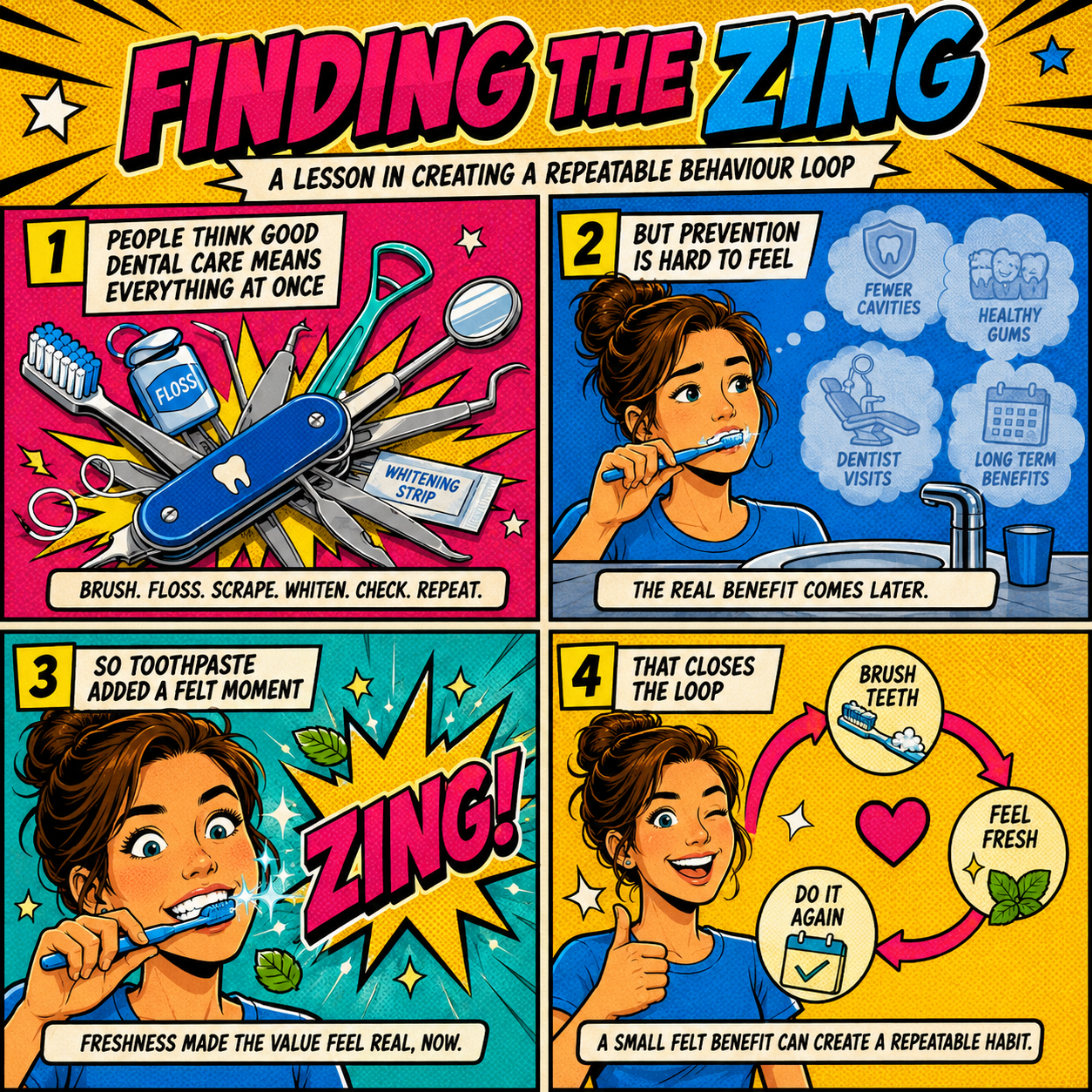
Toothpaste is a good example, because dental hygiene is mostly preventative. That is the problem. The real benefit is not usually available in the moment.
You brush your teeth so you do not get cavities later. So your gums stay healthy later. So you avoid pain, cost, decay, infection, shame, the horrible drilling noise, the stern conversation with the dentist six months from now.
But none of that is immediate, most of the real value is somewhere in the future and humans are not very good at building daily habits around invisible future benefits.
We can do it, sometimes. We can understand it intellectually and know something is good for us and still not do it. We can agree with the logic and still not feel pulled back to the behaviour.
So toothpaste had a problem.
The product was valuable, but the value was hard to feel. Brushing worked, but it did not necessarily give people an obvious moment of, yes, that did something.
So, as the story goes, toothpaste companies added the tingle. That little minty fresh cooling sensation, the feeling that your mouth is clean.
The Zing was not the science.
But it made the value legible.
It gave people something now for a benefit that mostly arrived later.
And that is the bit I keep thinking about. Because brushing your teeth is such a small behaviour. A toothbrush, some toothpaste, a sink and a mirror. Maybe two minutes, often less. It is not the whole dental system. It does not solve every oral health problem. It does not replace flossing, check-ups, orthodontics, gum care, diet, genetics, or any of the other things that sit around dental health.
But it creates a repeatable loop.
Brush. Feel fresh. Repeat.
The freshness is not the whole value, but it is the thing that helps the behaviour stick.
If you tried to introduce dental hygiene through the whole system, most people would never start. If the first product was a sort of Swiss Army knife of oral care, with a toothbrush, flosser, tongue scraper, whitening strip, sonic cavity checker, gum health dashboard, dentist booking tool, mouth mirror and plaque analytics, it might be technically more complete.
It might even be closer to the full vision of oral health.
But it would be too much, most people are not standing at the sink wanting a complete dental transformation platform.
They are half awake. They are trying to get out the door. They are looking for the toothpaste cap. They are thinking about coffee, school lunches, work, a meeting, the dog, whether the shirt they are wearing is clean enough.
They need the smallest useful thing that fits into that moment and then they need to feel something.
That is where I think a lot of MVPs go wrong.
We take the whole ambition and shrink it. We cut the features down. We remove some complexity. We make the first version smaller, cheaper, faster, rougher. And then we call it an MVP because it is not the whole thing yet.
But maybe that is not enough.
Maybe an MVP is not the smallest version of the product.
Maybe it is the smallest version of the behaviour loop.
What does someone do or feel and why would they do it again?
That is a different question.
Because a product can be viable and still not create a loop. It can work, be useful. It can be strategically correct. It can satisfy internal stakeholders, prove that the organisation can build the thing. It can even solve a real problem, at least in theory.
But if the person using it does not feel enough value to come back, it has not really taken hold.
It exists, but it has not entered their life.
The Zing does not have to be big. In fact, it is probably better if it is not big. Big promises are harder to trust. Big behaviour change is harder to sustain. Big new systems ask too much of people before they have any reason to believe.
The Zing is small.
It is the immediate signal that tells someone, this was worth doing.
A fresh mouth. A clearer next step. A little less anxiety. A task completed. A visible improvement. A feeling of progress. A tiny bit of relief.
Something.
Not the whole future benefit. Just enough now.
The toothpaste example also shows something else, which is that not everyone will use the whole system, and they do not need to.
Most people brush, but fewer floss every day.
Fewer use interdental brushes or water flossers or tongue scrapers or whitening strips or regularly book preventative appointments before something hurts.
That is not a failure of dental care. It is just how adoption works.
There are layers. There is the base behaviour almost everyone can understand. Then there are the deeper behaviours, the more committed behaviours, the more specialised behaviours, the behaviours people adopt once they have more motivation, more need, more trust, or more reason to care.
But if you confuse the later behaviours for the starting point, you build for the already convinced.
You build for the flosser, then wonder why everyone else is not coming.
I think this matters because product people, and organisations generally, tend to live much closer to the whole system than users do.
We can see the roadmap, the ecosystem, the long-term behaviour change. We can see all the adjacent use cases and the operational model and the commercial logic and the next three phases. We can see why it all matters.
But the person using it is standing at the sink.
That gap is everything.
The work is not just to make the thing viable, it is to make the value felt.
Especially when the thing you are asking someone to do now is meant to help them avoid a future they cannot yet see.
That is why the Zing matters.
So maybe the MVP question is not:
What is the smallest thing we can launch?
Maybe it is:
What is the smallest thing someone can do that gives them a reason to return?
Where is the Zing?
The Pattern
New essays when there's something worth saying
Not on a schedule. Subscribe and get the next one when it's ready.