The McDonalds Kitchen - Lessons in service design
Layla Foord
A reflection on working at McDonald’s as a teenager, learning about wastage, calling, customer service and the hidden systems behind work people often underestimate.
The McDonalds Kitchen
I learned young that wastage matters.
Not in a sustainability way, at least not at first. Not in the language of efficiency, margin, operational discipline, inventory management or whatever else I might call it now if I was trying to make it sound more serious than it felt at the time.
I learned it sitting side by side with Tolu after the store had closed, counting the food that had been thrown into the red bins.
Burgers. Fries. Apple pies.
I was sixteen, or maybe just under, in one of my many teenage jobs, this one at McDonald's, and at the end of the night there was this strange little ritual where everything that hadn't been sold had to be counted and entered into the system. Not guessed. Not sort of remembered. Counted. The store would be quiet by then in the way fast food places are quiet after closing, which is not really quiet at all, because the machines still hum and the floor is still sticky and everything smells faintly of oil and cleaning chemicals and cardboard. But the rush would be over. The customers gone. The performance finished.
And then we would count what we had got wrong.
That is how it felt, anyway.
Tolu would sit with me and we would enter it all in, item by item, and at the end he would tell me how much we had wasted that day. Not with drama. Not as if anyone had committed a crime. Just plainly. This is what we wasted. This is what it cost. This is what we'll change tomorrow.
And tomorrow mostly meant the calling.
The calling was one of those things that probably looks simple from the outside, because a lot of work looks simple when you are not the person doing it. Someone stands near the front and tells the kitchen how many burgers to make, how many with cheese, when to put more apple pies down, when to hold back, when to move faster. It sounds like shouting numbers. It was not shouting numbers.
It was reading the room.
You had this strange metal divider with a numbering system, and a very particular clock, and the food sat in the bay ready to be taken by a server. Each thing had a time. It could sit there, but not forever. Once the time clicked over, that was it. Into the bin it went. So the job was not just to make sure food was there. The job was to make sure enough food was there, at the right time, for a demand pattern that kept changing.
You had to judge the traffic in the store. You had to notice whether the queue was building or thinning. You had to know if the drive-through was about to pull people away from the front counter. You had to remember what tended to happen after school, or after the cinema, or when the weather was bad, or when a bus suddenly emptied itself nearby. You had to make the kitchen move without drowning them, and keep the front counter supplied without filling the bay with food that would become waste before anyone wanted it.
It was a tiny forecasting system, although I didn't know that then.
I just knew there was a right feeling to it.
Too much food in the bay and something felt wrong. Too little and the pressure came at you from every direction. The servers waiting. Customers watching. The kitchen trying to catch up. Someone asking where the cheeseburgers were. Someone else needing fries. The clock moving whether you were ready or not.
I liked it.
I liked the pace of it, the way you could feel the store as a system. I liked that there was a rhythm underneath the chaos, and if you paid enough attention you could almost get ahead of it. Not perfectly, but enough. Enough to make the next few minutes easier. Enough to stop the red bins filling up later.
I think that was the part I loved, really. The fact that the feedback loop was so short.
You made a call. The kitchen responded. The bay filled. The clock started. Customers arrived or didn't. Food sold or didn't. And at the end of the night, the red bins told the truth.
There was no long strategy cycle. No delayed dashboard. No meeting two weeks later where everyone debated whether the work had worked. You knew. You could see it in the waste, hear it in the queue, feel it in the tension of the team when the call was wrong.
And I think about that more often than probably makes sense.
Because so much later work tries to hide the red bins.
Organisations do it all the time. Product teams do it. Leadership teams do it. Whole companies do it. We make calls, build things, staff things, fund things, launch things, and then somehow lose sight of what is quietly being thrown away at the end of each day. Time. Attention. Trust. Goodwill. Energy. Features nobody uses. Meetings nobody needed. Work created because the system called for too much, too early, or in the wrong order.
But at McDonald's, the waste was there in front of you.
It had a smell.
It had a count.
It had a cost.
I learned other things there too, although at the time I just thought I was working.
I learned upselling and side-selling before I knew those words belonged anywhere outside a uniform. "Is that a large Coke?" "Would you like fries with that?" "Do you want to make it a meal?" It was all there, the small choreography of customer service and commercial nudging, wrapped in politeness and speed. You had to keep moving. You had to smile even when someone was rude, and listen while reaching for something else, and remember what they had ordered while someone behind you shouted for more nuggets.
I moved around a lot. From the fish fryer to the drive-through window, from front counter to parties, from the hot, greasy back of the store to the strange theatre of hosting children who had been fed sugar and given paper crowns and now needed someone to keep the whole thing from tipping into chaos.
I was good at it.
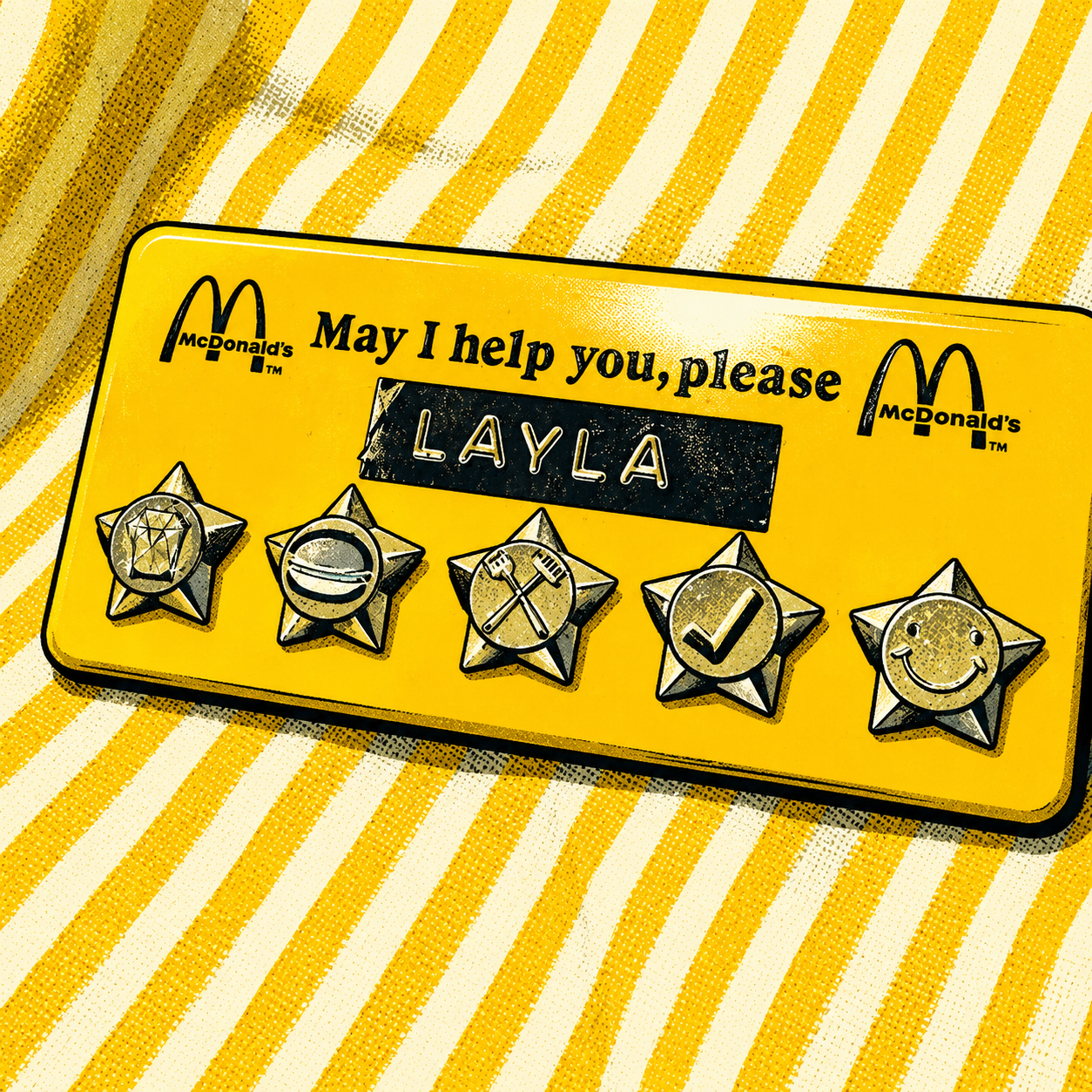
That still feels a bit funny to say, because being good at McDonald's is not the kind of thing people usually carry forward as a credential. But I was. I had hustler badges on my sleeves, little visible markers of how much I could sell in an hour. I had stars. I got shipped off to busy McDonald's stores to help when they needed extra people. Sometimes I hosted huge kids parties, which was really just another form of operations, except with smaller, louder stakeholders and more balloons.
There is something very clarifying about being good at a job that other people underestimate.
You learn that skill is not always where people think it is. It is not always in the places with status, or good lighting, or nice language around them. Sometimes skill is in noticing the queue before it becomes a problem. Sometimes it is in remembering the apple pies before the timer makes the decision for you. Sometimes it is in keeping your voice steady when six things need to happen at once. Sometimes it is in making a bored, tired, hungry person feel served quickly enough that they don't become someone else's problem.
In another world, I might have become a store manager.
I had started filling in the forms for a management course, or at least that is how I remember it. There was a sense that I could keep going, that there was a path there if I wanted it. Then they realised I was only sixteen, and that was that. Not in a dramatic way. Just one of those small administrative endings that changes the direction of a life without making much noise.
Then there was a little motorbike accident, and I had to leave.
The rest is history, except it isn't really, because some things come with you.
I still think about the calling.
I think about how easy it is to waste things when the people making the calls are too far away from the bins. I think about how much judgement sits inside work that looks procedural. I think about how systems need humans close enough to sense the pattern, but structured enough that the pattern can be acted on. I think about the difference between having enough ready and having too much waiting. I think about the cost of being wrong, and the dignity of counting it properly when you are.
And I still have my badge on my apron.
All the stars in place.
The Pattern
New essays when there's something worth saying
Not on a schedule. Subscribe and get the next one when it's ready.