The Scout
Layla Foord
A quiet, powerful story about the person in every community who watches the edges - and why that unseen role matters more than we know.
The Scout
There was a woman in the tribe whose job had never been formally given to her.
No elder had named it. No ceremony had marked it. No one had stood beside the fire and said, this one watches the edge.
But she did.
She noticed things.
The river had been lower for three seasons. The birds were leaving earlier. The children were coughing more in the cold months. The berries that used to grow near the eastern rocks had thinned. The animals were moving differently through the trees.
She noticed these things without trying.
Other things required more effort.
She could stitch cloth, but not beautifully. Her seams held, mostly, though they wandered. Sometimes she pricked her finger because her attention had moved to a change in the wind, or to the smell of rain before anyone else could sense it.
She could cook, but slowly. She had to think about the order of things. Her brother could prepare a meal as if the sequence lived in his hands: cut, soak, crush, stir, wait. She could do it too, but if someone interrupted her, or if the birds went suddenly quiet beyond the trees, she might lose her place and have to begin again.
She was not useless.
She carried water. She watched children. She gathered roots. She remembered who liked to sit near the fire and who preferred the edge of the circle. She knew when an old woman's cough had changed. She knew which child was pretending not to be hungry.
But she was not always smooth.
She moved too quickly sometimes. Or too slowly. She forgot small things and remembered strange ones. She could be listening to someone speak and also watching the cloud line behind them. She could be present and elsewhere at the same time.
People had words for this.
Distracted. Restless. Messy. Always wandering off.
They did not say these things cruelly, not always.
Sometimes they said them with affection. Sometimes with irritation. Sometimes with the weary certainty of people who believed they understood her place in the order of things.
She was the one who noticed too much and finished too little.
The one who asked odd questions.
The one who looked toward the ridge when everyone else was looking at the fire.
So when she spoke of the river, or the birds, or the animals moving differently, people heard it through what they already believed about her.
Of course she had been staring at the trees again.
Of course she had found something to worry about.
Of course she had made a pattern out of weather.
The river still ran. There was still food. The shelters still stood. The fires still held.
And she was, as everyone knew, easily pulled away by things at the edge.
So when she spoke, people smiled with the particular patience reserved for those who make life more complicated than it needs to be.
It has always been like this, they told her.
You worry too much.
We have enough.
Sit down.
And for a while, she tried.
She sat closer to the fire. She helped prepare food. She mended skins. She listened to the stories. She held children when their mothers were tired.
She tried to keep her attention where people wanted it.
On the pot. On the cloth. On the conversation in front of her.
But even while her hands were still, something in her kept listening beyond the circle.
To the tree line. To the clouds. To the silence where birdsong used to be. To the old people rubbing their knees in the morning cold. To the young hunters coming back with less than they expected.
Eventually she walked out.
Not because she wanted to leave.
Because she needed to know.
She walked beyond the usual paths, past the places the children were allowed to play, past the rocks where the hunters sharpened blades, past the ridge where the land opened and became unfamiliar.
She did not walk like someone escaping.
She walked like someone gathering proof.
She watched where the ground softened. She listened for water. She marked the trees in her memory. She noticed which slopes would be too steep for the old people, which stones would be dangerous for small feet, which parts of the river might be crossed if the rains came late.
After many days, she found another valley.
There was water there. Better shelter from the wind. A deeper line of trees. More signs of animals. Ground that would hold.
She stayed long enough to understand the route.
Where the children could walk. Where the elders would need help. Where the river could be crossed. Where the dangerous ground began.
Then she came back.
This, of course, was when she became a problem.
It is hard to bring news from beyond the edge when people are still comfortable at the centre.
She tried to explain what she had seen.
Not all at once. Not dramatically.
She spoke of the river. The weather. The animals. The valley.
She said they did not need to leave tomorrow, but they needed to prepare. They needed to gather what mattered. They needed to understand the route before fear made the route harder.
Some listened.
Most did not.
A few were irritated. A few were frightened. Some thought she wanted authority. Some thought she wanted attention. Some thought she was insulting the elders by suggesting that the place they had chosen might no longer be safe.
You are unsettling people, they told her.
You are making everyone nervous.
You keep looking for problems.
Why can't you just stay here and help with what is in front of us?
She tried to answer carefully.
She said she was not saying the elders were wrong. She said she was not saying the tribe had failed. She said she was not saying they should abandon everything.
She had only walked ahead.
She had only seen another place.
She had only thought they might need more time.
But the more she explained, the more it seemed she was defending something she had not said.
The conversation was no longer about the river.
Or the animals. Or the valley. Or the route.
It was about her.
Her tone. Her certainty. Her restlessness. Her inability to leave things alone.
So she stayed quiet for a while.
She learned to soften what she saw. She learned to make her warnings smaller. She learned to turn observations into questions, and questions into jokes, and jokes into silence.
But the river kept falling.
The animals kept moving.
The coughs got worse.
And then, one night, the storm came hard enough that everyone could hear it.
By morning, the shelters near the lower ground were damaged. The food stores had taken water. One of the old trees had fallen across the path where the children usually played.
Suddenly, the question was no longer whether the tribe should move.
The question was how quickly.
And then they needed her.
Not because she had been right.
Being right was not the point.
They needed her because she had already walked the path.
She knew where the ground softened. She knew where the river narrowed. She knew which ridge could be crossed with children. She knew where the elders would need to rest.
So she helped them move.
She did not say, I told you.
There was no time for that, and no kindness in it.
She carried what she could. She walked beside the frightened ones. She showed the hunters where to turn. She helped the elders across the stones. She went back twice for those who had fallen behind.
When they reached the new valley, the tribe began to settle.
The fires were lit. The children ate. The old people were wrapped against the cold.
People spoke of how fortunate they had been.
They praised the strength of the hunters. The wisdom of the elders. The resilience of the families. The courage of the group.
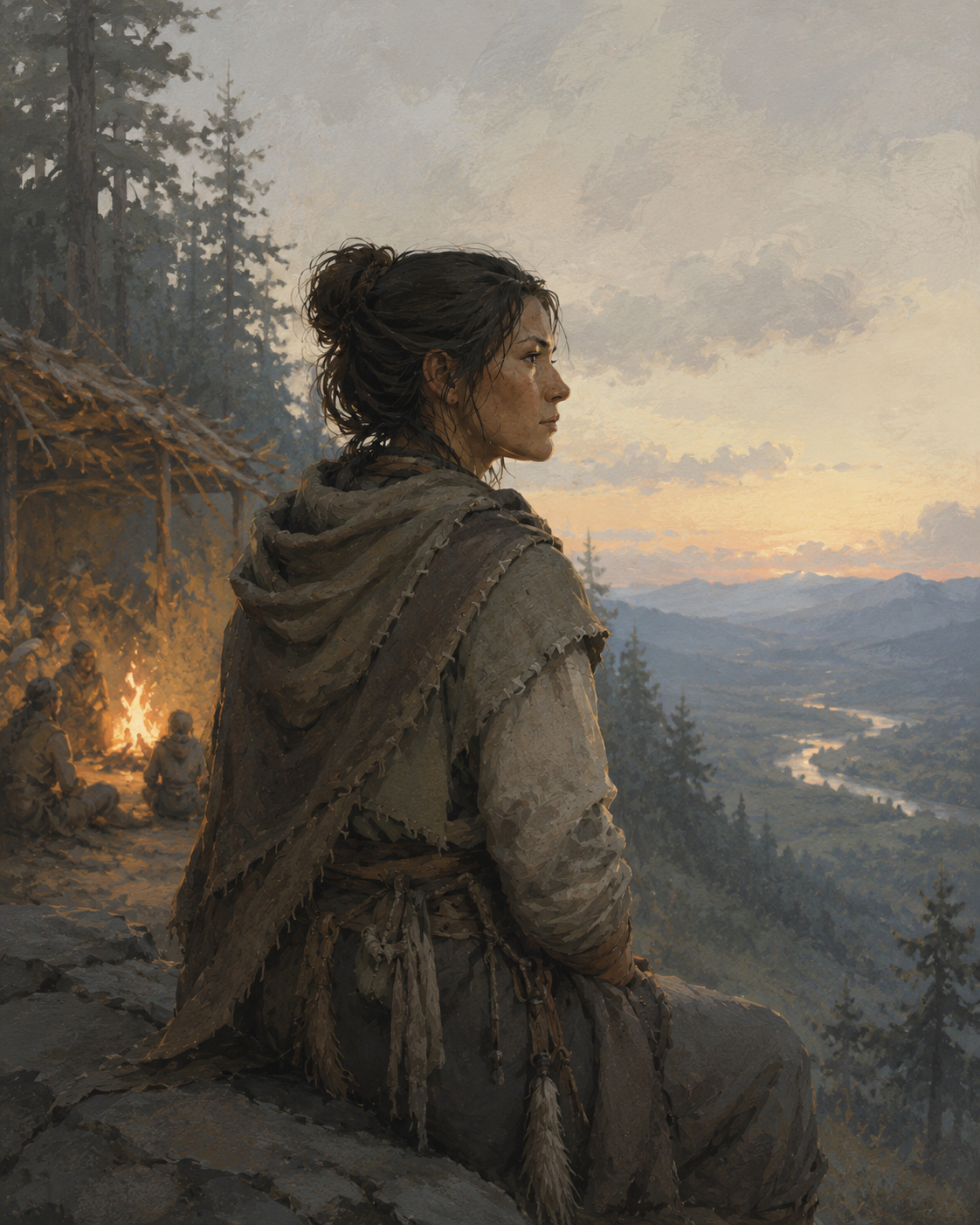
The scout sat just outside the circle of firelight and said very little.
She was tired.
Not only from the walking.
From all the months of seeing before seeing was allowed.
After a while, one of the children came and sat beside her.
The child did not ask why she had gone so far. Or why the others had not listened. Or whether she had been afraid.
The child only looked out beyond the new valley, toward the dark line of trees.
Then, very quietly, she asked,
What do you see now?
The scout did not answer straight away.
She watched the fire. She watched the trees. She listened to the river moving in the dark.
Then she put one hand on the ground beside her, as if feeling whether the earth would hold.
And she kept watching.
The Pattern
New essays when there's something worth saying
Not on a schedule. Subscribe and get the next one when it's ready.